
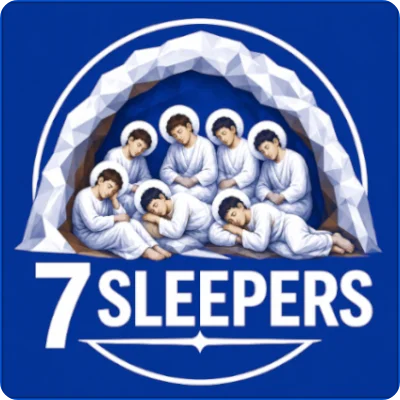
Seven Sleepers of Ephesus
Full Story
The complete narrative as preserved in Christian tradition — persecution, sealed cave, centuries of sleep, and a dramatic awakening.
01 · The Persecution
Ephesus under Emperor Decius
Around the year 250 CE the Roman emperor Decius issued an empire-wide edict requiring every inhabitant to sacrifice to the traditional Roman gods and obtain a certificate (libellus) proving compliance. Refusal meant imprisonment, torture, or death. This was one of the first systematic, empire-wide persecutions of Christians.
In the great city of Ephesus, seven young men of high standing — often named Maximian (or Maximilian), Malchus, Martinian, Dionysius, John, Serapion, and Constantine (names vary by tradition) — refused to deny their faith. They were arrested, questioned, and given a short period of time to reconsider while Decius continued his journey.
02 · Flight to the Cave
Withdrawal and sealing
Instead of submitting, the seven distributed their possessions to the poor, kept only a few coins, and withdrew to a cave on a mountain outside Ephesus (variously called Mount Ochlon, Anchilos, Celion, or Pion). There they devoted themselves to prayer, preparing for possible martyrdom.
When Decius returned and learned of their flight, he ordered the mouth of the cave blocked with large stones and sealed. Two Christian secretaries, Theodore and Rufinus, are said to have written an account of the events and placed it among the stones so that the memory of the young men would not be lost.
Inside the sealed cave the seven fell into a miraculous sleep. Their bodies remained incorrupt; their clothing did not age.
03 · The Long Sleep
Centuries pass
Decius died in 251. The Roman Empire changed profoundly. Christianity moved from a persecuted minority to the favored religion of the state under Constantine and his successors. Generations lived and died. The sealed cave was forgotten by most.
Traditional Christian calculations place the length of the sleep between roughly 195 and 300 years. The most common figures in the Latin and Greek traditions are around 196–208 years or approximately 300 years, ending in the reign of Theodosius II (408–450 CE).
04 · The Awakening
A new world
During the reign of Theodosius II a controversy arose in the Church concerning the resurrection of the body. Some denied that the physical body would rise. At that very time a landowner (sometimes named Adolius) decided to open the old cave, either to use it as a cattle pen or to extract building stone.
When the stones were removed, the seven awoke. They believed they had slept only a single night. Feeling hungry, they sent one of their number (often identified as Malchus or Diomedes) into the city with the old coins they still carried to buy bread.
The young man was astonished by the changes: crosses on buildings, open Christian worship, a completely different emperor’s name on the coins. When he tried to pay with the ancient Decian coinage, the merchants accused him of finding buried treasure. He was brought before the authorities and eventually before the bishop and the emperor himself.
05 · Aftermath
Witness and death
The emperor Theodosius II and the people of Ephesus went out to the cave. The seven sleepers recounted their story. Their reappearance was immediately understood as a divine confirmation of the bodily resurrection. Shortly afterward the young men lay down again and died a final death. A church or basilica was built over the site, and the place became a center of pilgrimage.
The Meaning
The legend was never primarily about the length of the sleep. It was about God’s power over time and death, and the certainty that the same bodies that die will rise again.